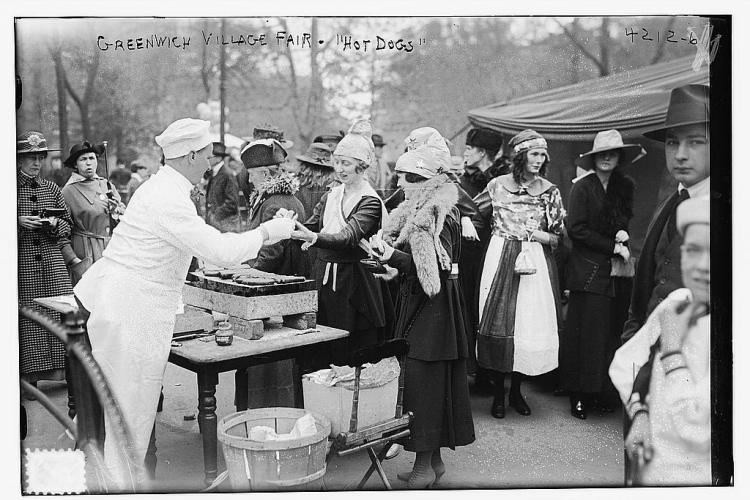
Greenwich Village Fair – “Hot Dogs” – June 1917 photograph: Library of Congress The term hot dog denotes a sausage, especially a frankfurter, served hot in a long roll split lengthways. In US slang, the noun dog has been used to denote a sausage since the late 19th century. This usage is first recorded […]
photograph: Farm Shop The noun mayonnaise denotes a thick, creamy sauce consisting of egg yolks emulsified with oil and seasoned, used as a cold dressing or accompaniment for salad, eggs, fish, etc., or as the base for other sauces. It is used in two French phrases: la mayonnaise prend, literally, the mayonnaise […]
The phrase to leave no stone unturned means to try every possible course of action in order to achieve something. (The equivalent French phrase has a cosmic dimension since it is remuer ciel et terre, literally, to move heaven and earth.) The image of turning every stone was already proverbial over 2000 years ago in […]
The sandwich (item of food consisting of two pieces of bread with a filling between them) is named after the British statesman John Montagu (1718-92), 4th Earl of Sandwich. It is generally said that the sandwich was invented because he once spent twenty-four hours at the gaming-table without other refreshment than some slices of beef […]
The phrase to steal someone’s thunder means: to use the ideas, policies, etc., devised by another person, political party, etc., for one’s own advantage or to anticipate their use by the originator. It is said to have originated in an exclamation by the English critic and ineffective playwright John Dennis (1658-1734). After the early demise […]
The term thinking cap denotes an imaginary cap humorously said to be worn in order to facilitate thinking. The earliest instance that I have found is from the Western Carolinian (Salisbury, North Carolina) of 16th October 1821: We advise the editor to put his thinking-cap on, before he hazards another such assertion. The term also […]
A blend of turkey, duck and chicken, the noun turducken designates a poultry dish consisting of a boned chicken inside a boned duck which is in turn placed inside a partially boned turkey, along with seasoned stuffing between the layers of meat and in the central cavity, the whole typically being cooked by roasting. It […]
Eastern Vaudeville Bans Unseemly Slang A general order has been sent out from the Keith office to all Keith, Moss and Proctor vaudeville houses, instructing resident managers to hereafter bar the use by artists of the current slang phrases, “That’s the Cat’s Meow,” “Cat’s Pajamas,” “Hot Dog,” “Hot Cat,” etc. This means the phrases […]
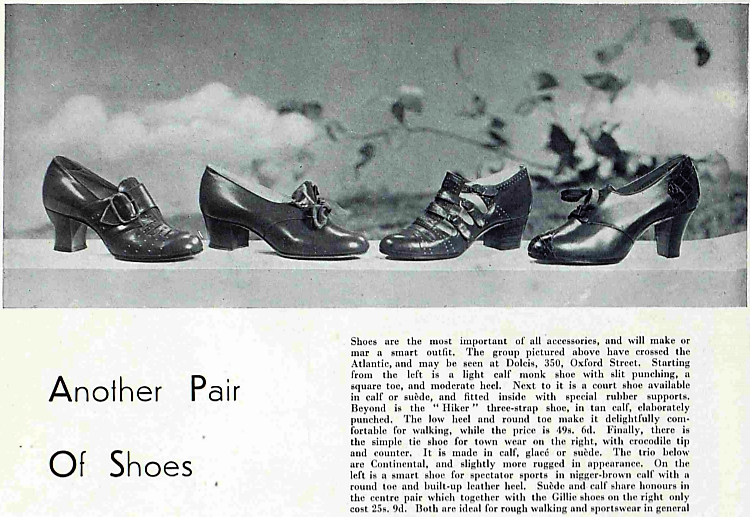
Another Pair Of Shoes Shoes are the most important of all accessories, and will make or mar a smart outfit. The group pictured above have crossed the Atlantic, and may be seen at Dolcis, 350, Oxford Street. Starting from the left is a light calf monk shoe with slit punching, a square toe, and […]
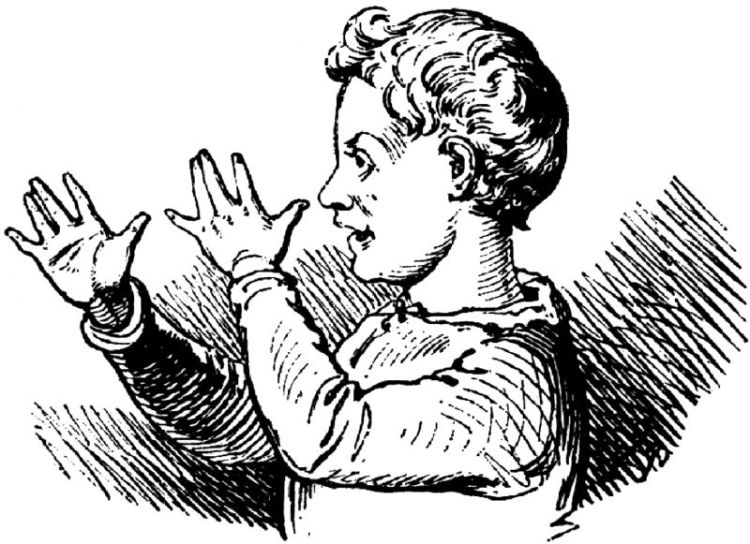
The phrase to cock (also to cut, to pull) a snook, or snooks, means: – literally: to make a gesture of derision by putting one’s thumb to one’s nose and outspreading the fingers; this gesture can be intensified by joining the tip of the little finger to the thumb of the other hand, whose fingers are […]



 word histories