‘like a Bondi tram’: meaning and origin
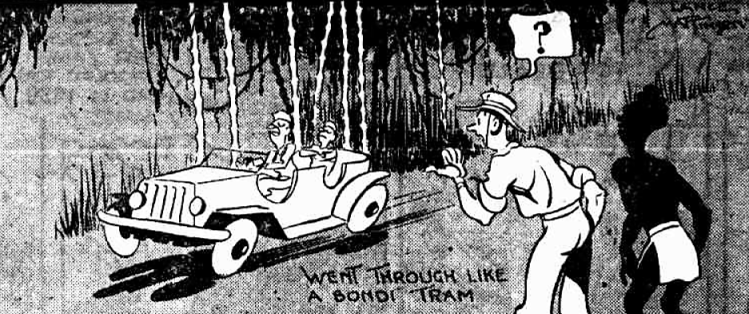
Australia, 1940—means ‘speedily’—refers to the tram service between Sydney, New South Wales, and Bondi Beach, a popular beach located 4 miles east of Sydney city centre
Read More
“ad fontes!”
Australia, 1940—means ‘speedily’—refers to the tram service between Sydney, New South Wales, and Bondi Beach, a popular beach located 4 miles east of Sydney city centre
Read MoreAustralia, 1888—defined by Wilkes in A Dictionary of Australian Colloquialisms (1990) as “An imaginary rich uncle overseas, backing some venture in which the unwary may be persuaded to invest.”
Read MoreAustralia, 1888—denotes a letter (i.e., a written message)—‘yabber’: as a noun, denotes speech, language, talk; as a verb, means to talk—from an aboriginal stem ‘ya’, meaning to speak
Read MoreBritish English, 1843—The theatrical phrase it will be (or it will come) all right at night (or all right on the night) means the opening night will go well.
Read Moreoriginated (1915) as the jocular beginning, destined to grip the reader’s attention, of a hypothetical novel or short story—soon (1919) came to be also used either without precise meaning or as a jocular exclamation
Read More1947—is used to express an attitude of insularity and hostility to foreigners attributed to the British—a shortening of ‘golliwog’, the derogatory and offensive noun ‘wog’ designates a non-white person
Read Moretitle of a CBS television documentary first broadcast in 1966—came to be used derogatorily of any fast package-tour—gave rise to the pattern ‘(if) it’s Tuesday, this (or it) must be ——’, used of travel anywhere
Read More1979—nickname given, in particular, to singer Olivia Newton-John—alludes to the type of popular music that (like a milkshake) is discarded as soon as it has been consumed
Read Morereply to any request for somebody’s whereabouts—Australia, 1944: slang of the Australian armed forces during WWII—original meaning: absent without leave
Read MoreUSA, 1976—Australia, 1982—trendy middle- to upper-middle-class people, who are often conservationists, and who, in some cases, have moved from cities and urban areas into country areas
Read More word histories