The phrase ‘the sky’s the limit’ originated in poker.
meaning: ‘there is nothing to prevent someone or something from being successful’—from a late-19th-century metaphor specifically used of poker games with ‘a sky-high limit’ on stakes
Read More
“ad fontes!”
meaning: ‘there is nothing to prevent someone or something from being successful’—from a late-19th-century metaphor specifically used of poker games with ‘a sky-high limit’ on stakes
Read MoreUSA—‘to look, or to feel, (like) a million dollars’, or ‘(like) a million bucks’: to look, or to feel, extremely good, or extremely attractive (early 20th century)—sometimes used in contrast to ‘like thirty, or 30, cents’: cheap, worthless (late 19th century)
Read Morerobotically conformist or obedient—from The Stepford Wives (1972 novel by Ira Levin and 1975 film adaptation by Bryan Forbes), in which Stepford is the name of a superficially idyllic suburb where the men have replaced their wives with obedient robots
Read Moreoriginally: a child wearing the house key tied around their neck and staying in the streets while their mother is at work—USA, 1935: a poor Afro-American woman’s child—USA & UK, WWII: a child whose mother was engaged in war industry
Read MoreUSA, 1901—Especially in ‘to have them rolling in the aisles’, the colloquial phrase ‘in the aisles’ is used in various expressions to suggest a wildly enthusiastic reaction, especially uncontrollable laughter, on the part of an audience.
Read MoreUSA, 1850—indicates that precedence should be given, or deference shown, to an older person—in extended use: an invitation to somebody (not necessarily older) to go first when passing through a door, etc.—pays a compliment to the person giving precedence
Read MoreUSA, 1914—‘ailurophile’: a cat lover—‘ailurophobe’: opposite sense—based on ancient Greek ‘aílouros’, ‘cat’, perhaps from ‘aiόlos’, ‘swift’, and ‘ourá’, ‘tail’, the cat being perhaps so called on account of the swift movement to and fro of its tail
Read Morefrom the notion that even a dead cat will bounce if dropped from a sufficient height—UK, 1981: a rapid fall in the stock market with hardly any reaction—USA, 1985: a rapid but short-lived recovery in the stock market after a sharp fall—hence, 1992: any spurious success
Read More‘a stiff upper lip’: a quality of uncomplaining stoicism—now understood as referring to what is believed to be a quintessentially British trait, the repression of emotion, but originated in fact in North America (USA, 1811)
Read More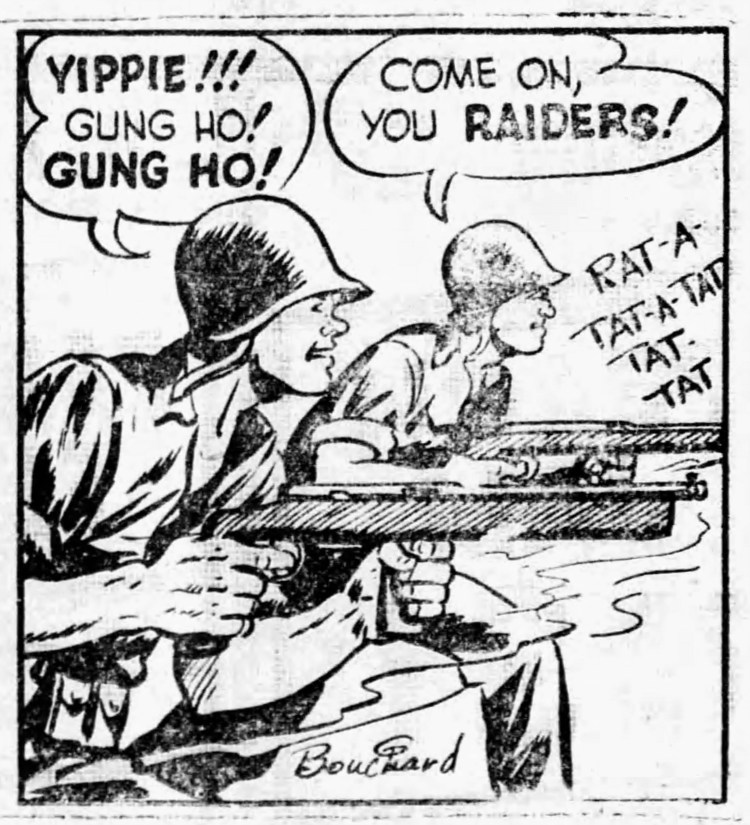
from Chinese ‘gōnghé’, short for ‘Zhōngguó Gōngyè Hézuò Shè’ (Chinese Industrial Cooperative Society)—interpreted as a slogan meaning ‘work together’ (USA, 1941)—adopted by Evans F. Carlson, commander of the 2nd Marine Raider Battalion (1942)
Read More
