MEANINGS – attractive articles of little value or use – practices or beliefs that are superficially or visually appealing but have little real value or worth ORIGIN The noun trumpery, first recorded in the mid-15th century, is from the French noun tromperie, which means deception, trickery. This was one of the original meanings in […]
MEANING the depths of one’s conscience or emotions ORIGIN This anatomically curious but firmly established expression is a variant of the older and more comprehensible heart of heart, meaning very centre of the heart, which was coined by the English poet and playwright William Shakespeare (1564-1616) in The Tragicall Historie of Hamlet, […]
The Latin noun halcyon, more properly alcyon, was derived from Greek ἀλκυών (= alkuon), incorrectly spelt ἁλκυών (= halkuon), meaning kingfisher. The ancients fabled that the halcyon bred about the time of the winter solstice in a nest floating on the sea, and that it charmed the wind and waves so that the sea was […]
The term field bishop denotes a person who is hanged and imagined as grotesquely giving a benediction with his jerking legs. It is first recorded in A mysterye of inyquyte contayned within the heretycall genealogye of Ponce Pantolabus (1545), by John Bale (1495-1563), Bishop of Ossory, evangelical polemicist and historian: What your ende shall be […]
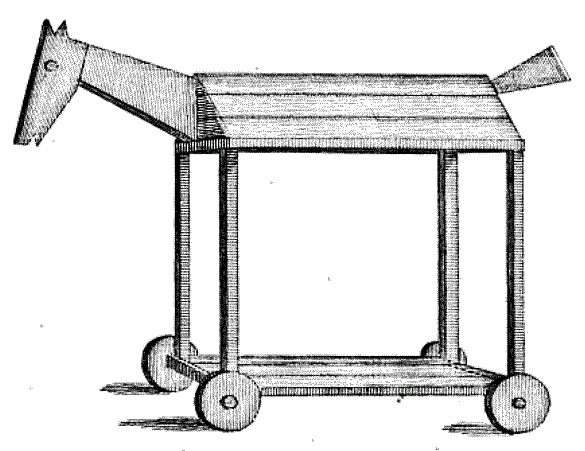
The phrase a horse that was foaled of an acorn denoted the gibbet, sometimes also called triple tree. In A Collection of English Proverbs (1678), the English naturalist and theologian John Ray (1627-1705) wrote: You’ll ride on a horse that was foal’d of an acorn. That is the gallows. Pelham; or, The Adventures […]
The expression short shrift means brief and unsympathetic treatment, and to make short shrift of means to dispose of quickly and unsympathetically. A short shrift was originally a brief space of time allowed for a criminal to make his or her confession before execution. The expression is first recorded in The Tragedy of King Richard […]
According to the post-biblical Christian tradition, the apple is the fruit of the tree of knowledge of good and evil eaten by Adam and Eve in the Garden of Eden in defiance of God’s commandment. However, in the Book of Genesis, the type of fruit eaten by Adam and Eve is not specified. In the King James Version (1611), the two […]
The phrase to miss the bus, or the boat, etc., means to be too slow to take advantage of an opportunity. In A Concise Dictionary of Phrase and Fable (1993), B. A. Phythian explained: This expression is said to originate in an Oxford story of the 1840s about John Henry Newman, fellow of Oriel College, […]
MEANING a place or state of utter confusion and uproar ORIGIN In Paradise Lost (1667), the English poet John Milton (1608-74) invented Pandæmonium, with a capital P, as the name for the capital of Hell, containing the council chamber of the Evil Spirits. This noun is from ancient Greek παν- (= pan-), […]
MEANING outside the limits of social convention ORIGIN The primary meanings of the noun pale are a wooden stake or post used with others to form a fence and a wooden fence made of stakes driven into the ground. This word appeared in the late 14th century and is from Anglo-Norman and Middle French pal, meaning a stake, a palisade, a […]

 word histories