Australia—1954: a very unpleasant experience—originally, 1953: a particularly rough stretch of road on the 6,500-mile round-Australia Redex Reliability Trial of August-September 1953—hence, 1953: any particularly rough stretch of road
USA, 1963—a female police officer or a female traffic warden—puns on ‘dick’, slang for a man’s penis, and the name of Dick Tracy, a comic-strip detective created in 1931 by the U.S. cartoonist Chester Gould
to live in conditions of extreme want—Australia, 1832; Ireland and Britain, 1834; USA, 1846—in early use, the phrase frequently occurs in relation to Ireland and to the armed forces
Australia, 1970—a Melbourne City Council parking officer—the adjective ‘grey’ refers to the colour of those officers’ uniform; the noun ‘meanie’ refers to the nastiness displayed by those officers in the accomplishment of their duties
USA—‘blue-sky talk’ 1900—‘blue-sky research’ 1947—the adjective ‘blue-sky’ is used to mean: (in negative sense) fanciful, hypothetical; (in positive sense) creative or visionary—from the notion of a blue sky as a place free from disturbances or difficulties
informal and often humorous: denotes the explicit or most intimate details of something—originally (USA, 1859) referred to accounts or representations of acts of violence and bloodshed
UK, 1995—a derogatory designation of New Labour, i.e., a right-wing/social democratic trend in Labour thinking and policy, advocated by Tony Blair—‘Tory’: the British Conservative Party; ‘lite’ (phonetic respelling of the adjective ‘light’): a moderated version of something
1950—the exercise of ploys and tactics in order to minimise time spent waiting in a queue—composed of the noun ‘queue’ and the suffix ‘-manship’—here, ‘-manship’ does not refer to the skills worthy of a role, as in ‘horsemanship’ and ‘statesmanship’, but to the ploys used to gain the upper hand, as in ‘gamesmanship’
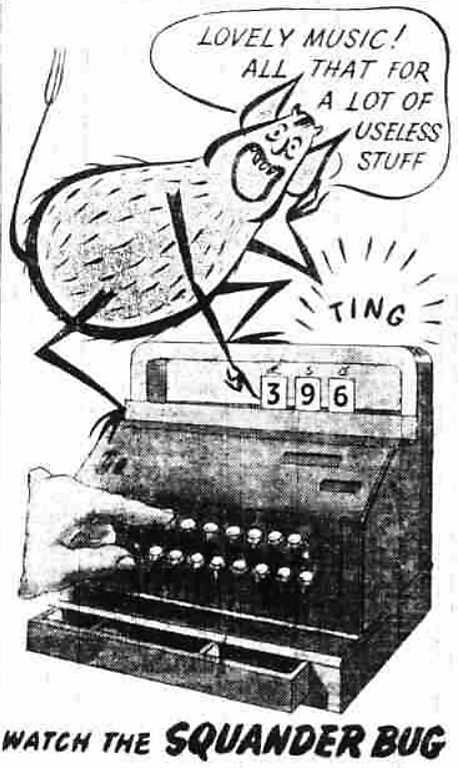
1943—a devilish insect symbolising reckless extravagance and waste—introduced by the National Savings Committee in a government publicity campaign promoting economy—hence: one who is profligate with money or resources
UK—(used of a group of people) to keep passing the initiative or responsibility from one person to another, so that no action is taken—refers to a party game in which a gift wrapped in several layers of paper is passed around a circle of players to the accompaniment of music, the losers in successive rounds being those holding the parcel when the accompanying music stops