‘Hobby’, diminutive of ‘Hob’, pet form of ‘Robert’, was used to denote a small horse, hence a child’s toy with a horse’s head, hence a favourite occupation—cf. French ‘dada’, child’s word for horse, used to denote a favourite pastime
Twelfth Day denotes the twelfth day after Christmas, i.e. 6th January, on which the festival of the Epiphany is celebrated, and which was formerly observed as the closing day of the Christmas festivities. (Epiphany denotes the festival commemorating the manifestation of Christ to the Gentiles in the persons of the Magi; via Old-French and Anglo-Norman forms such as epyphane (Modern […]
‘baloney’ or ‘boloney’: ‘humbug’ and ‘nonsense’—USA, 1922—American-English alteration of ‘bologna (sausage)’, a large smoked sausage made of seasoned mixed meats, from the name of Bologna, a city in northern Italy, where these sausages were first made
18th century—origin unknown—perhaps originally imitative and comparable to, or derived from, ‘tantara’, denoting the sound of a trumpet, hence an uproar—or from obsolete French ‘trantran’, synonym of ‘tantara’
Etymologically, a jewel is a little game, a little plaything: ‘jewel’ is from a French diminutive of ‘jeu’, meaning ‘a game’, ‘a play’. The word ‘bijou’ is from Breton ‘bizou’, meaning ‘a finger-ring’, from ‘biz’, ‘finger’.
The name ‘Indian summer’ (late 18th century) reflected the fact that to the Europeans living in the New World, this was a newly-discovered local phenomenon. But similar phenomena were already known in the Old World by various names.
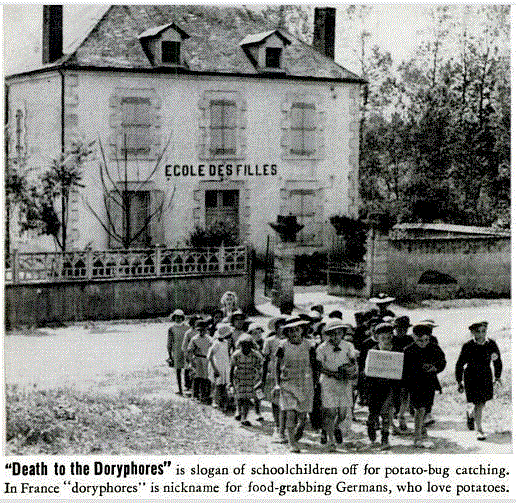
Greek ‘δορυϕόρος’ (‘doruphόros’) meant ‘spearman’; in French, ‘doryphore’ denotes the Colorado beetle and the German occupying forces during WWII; in English, it denotes a pedantic and annoyingly persistent critic.
The English noun ‘pound’ is from Latin ‘pondō’, short for ‘lībra pondō’, literally ‘a pound’ (= ‘lībra’) ‘by weight’ (= ‘pondō’)—Latin ‘lībra’ meant ‘the Roman pound of twelve ounces’, and ‘pondō’ was a form of ‘pondus’, meaning ‘weight’.
‘queen’s’, or ‘king’s’, ‘cushion’: a seat made by two people who cross arms and hold each other’s hands to form a support for another person—Scotland and northern England, 19th century
The original meaning of beer o’clock is 5 p.m. as the end of the working day. Its first known user was Stephen King (born 1947), American author of novels of horror and suspense.



 word histories