‘piehole’: meaning and origin
a person’s mouth—U.S. slang, 1983
Read More
“ad fontes!”
a person’s mouth—U.S. slang, 1983
Read More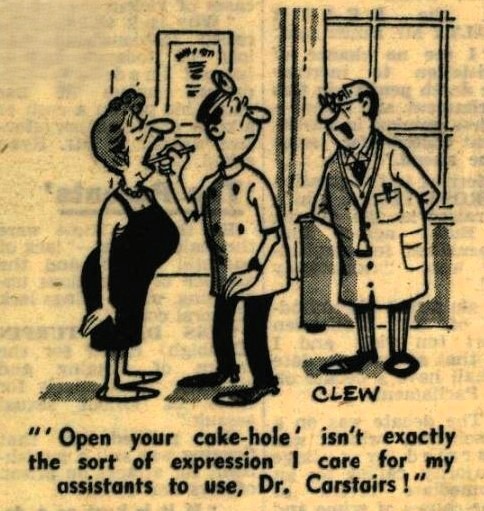
a person’s mouth—British-Army slang, 1916
Read MoreYorkshire & Lancashire, 19th century—wisdom, a witty remark, etc., which occurs to a person after the event, typically too late to be of use
Read Morealso ‘moustache of milk’—UK, 1872—a white residue, resembling a growth of hair above the upper lip, left after drinking milk
Read More1777, in a translation of a letter written by Voltaire in 1768—a loan translation from French ‘l’histoire n’est qu’une fable convenue’, first used in 1758 by the French philosopher Claude Adrien Helvétius
Read MoreAustralia, 1957—to gain weight around one’s middle
Read More1546—of little or no worth—here, ‘pudding’ refers to a sausage-like mass of seasoned minced meat, oatmeal, etc., stuffed into a prepared skin and boiled
Read More1666—a warning or exhortation to say nothing about a particular matter—of unknown origin—may allude to the mysterious nature of pudding stuffing
Read More1687—a lengthy and tedious reprimand—from the verb ‘job’ (1666), meaning: to reprimand in a long and tedious harangue—with allusion to the lengthy reproofs addressed to Job by his friends in the Book of Job
Read Morealso, and originally (1729), ‘to make a long story short’: to be brief or concise—this phrase is typically used as a sentence adverbial, with the sense: in short, in summary, briefly
Read More word histories