In early use, apple was a general term for all kinds of fruits other than berries, including even nuts. In fact, apple and berry are the only Anglo-Saxon fruit names, the rest being of Latin or ‘exotic’ origin. This is why apple was commonly used in describing foreign fruits, which explains for example the word […]
The phrase ‘a pretty kettle of fish’ originally referred to a net full of fish, which, when drawn up with its contents, is suggestive of confusion, flurry and disorder—‘kettle’ being a form of ‘kiddle’, a noun denoting a dam or other barrier in a river, with an opening fitted with nets to catch fish.
“Go by Shanks’ pony – Walk short distances and leave room for those who have longer journeys” – a Second World War poster by Lewitt-Him for the Ministry of War Transport – image: Imperial War Museums The phrase Shanks’(s) pony, or mare, etc, means one’s own legs as a means of conveyance. It is […]
MEANING The phrase to beggar belief (or description) means to be too extraordinary to be believed (or described). ORIGIN The literal meaning of the verb to beggar is to make a beggar of, exhaust the means of, reduce to beggary. It came to be used figuratively to mean to exhaust the resources […]
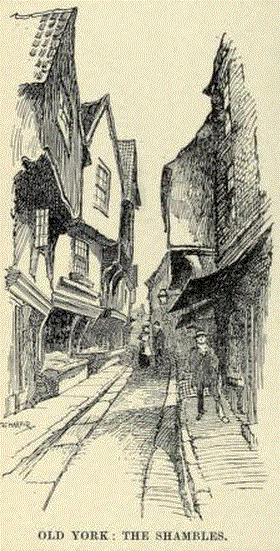
Old York: the Shambles – illustration by Charles G. Harper for his book The Great North Road: The Old Mail Road to Scotland: York to Edinburgh (1901) (The pavements are raised either side of the cobbled street to form a channel where the butchers would wash away the offal and blood.) MEANING […]
The phrase to carry coals to Newcastle means to supply something to a place where it is already plentiful; hence, figuratively, to do something wholly superfluous or unnecessary—cf. also to sell refrigerators to the Eskimos and to sell sand in the Sahara. This phrase (in which coals is an obsolete plural) refers to Newcastle upon Tyne, in […]
MEANING a young man paid or financially supported by a woman, typically an older woman, to be her escort or lover ORIGIN In English, gigolo originally denoted a professional male dancing-partner. One of its first users was the American novelist, short story writer and playwright Edna Ferber (1885-1968) in Gigolo, which was published in […]
MEANING to smell a rat: to detect something suspicious ORIGIN The first known use of this phrase is in The Image of Ipocrysy, an anonymous poem written around 1540, denouncing “the cruell clergy”: (published in 1843) Suche be owr [= our] primates, Our bisshopps and prelates, Our parsons and curates, With other […]
The word teetotum, which dates back to the 18th century, denotes a small four-sided disk or die having an initial letter inscribed on each of its sides, and a spindle passing down through it by which it could be twirled or spun with the fingers like a small top, the letter which lay uppermost, when […]
The phrase to sleep like a top means to sleep very soundly. In A Concise Dictionary of Phrase and Fable (1993), B. A. Phythian explains that, unlikely as it may seem, the top referred to here is the child’s toy which seems not to be moving when it is spinning, though it wobbles when being […]