image: nageur-sauveteur MEANINGS The noun starboard denotes the side of a ship or aircraft that is on the right when one is facing forward, while port denotes the opposing side. ORIGINS From the Germanic bases of the nouns steer and board, starboard, which appeared in Old English as steorbord, denotes literally the steer board, the steer side. This side of the ship […]
The proper name Guy is derived, via French, from the Old German Wido, either from wit, meaning wide, or from witu, wood. Wido has become Guy in French because in words of Germanic origin, when initial, the labio-velar approximant /w/ has regularly become the velar /g/. For instance, in the French noun loup-garou, the element garou corresponds to English werewolf—in fact, loup was added when the […]
The word Mayday, which dates from 1923, is used as an international radio distress signal, especially by ships and aircraft. It was supposedly coined by Frederick Stanley Mockford (1897-1962), a senior radio officer at London’s Croydon Airport, but this has not been substantiated: the fact that this story has often been repeated gives it a semblance […]
MEANING any plant of the European genus Reseda, including mignonette and dyer’s rocket, which has small spikes of greenish, yellowish or whitish flowers ORIGIN Through translations of Naturalis Historia (Natural History – 77), a vast encyclopaedia of the natural and human worlds by the Roman statesman and scholar Pliny the Elder […]
Unexpectedly, the words fawn, meaning a young deer in its first year, and fetus (or foetus), meaning an unborn or unhatched offspring of a mammal, are doublets: they go back to the same etymological source but differ in form and meaning. While fetus has remained identical to this source, the form fawn is the result of sound changes—cf. also turban – tulip, clock – cloak, […]
The term Richard Snary is an alteration, with humorous substitution of Richard for the pet-form Dick, of Dick Snary, itself a humorous remodelling of dictionary. These terms are first recorded in Apollo shrouing composed for the schollars of the free-schoole of Hadleigh in Suffolke. And acted by them on Shrouetuesday, being the sixt of February, 1626, by William Hawkins (died 1637): – I […]
The noun galaxy is from post-classical Latin galaxias, denoting the Milky Way, from Hellenistic Greek γαλαξίας (= galaxias), short for γαλαξίας κύκλος (= galaxias kuklos), milky circle, from ancient Greek γάλα/γαλακτ- (= gala/galakt-), milk. Originally therefore, galaxy, often with the and capital initial, denoted the Milky Way, that is, the diffuse band of light stretching across […]
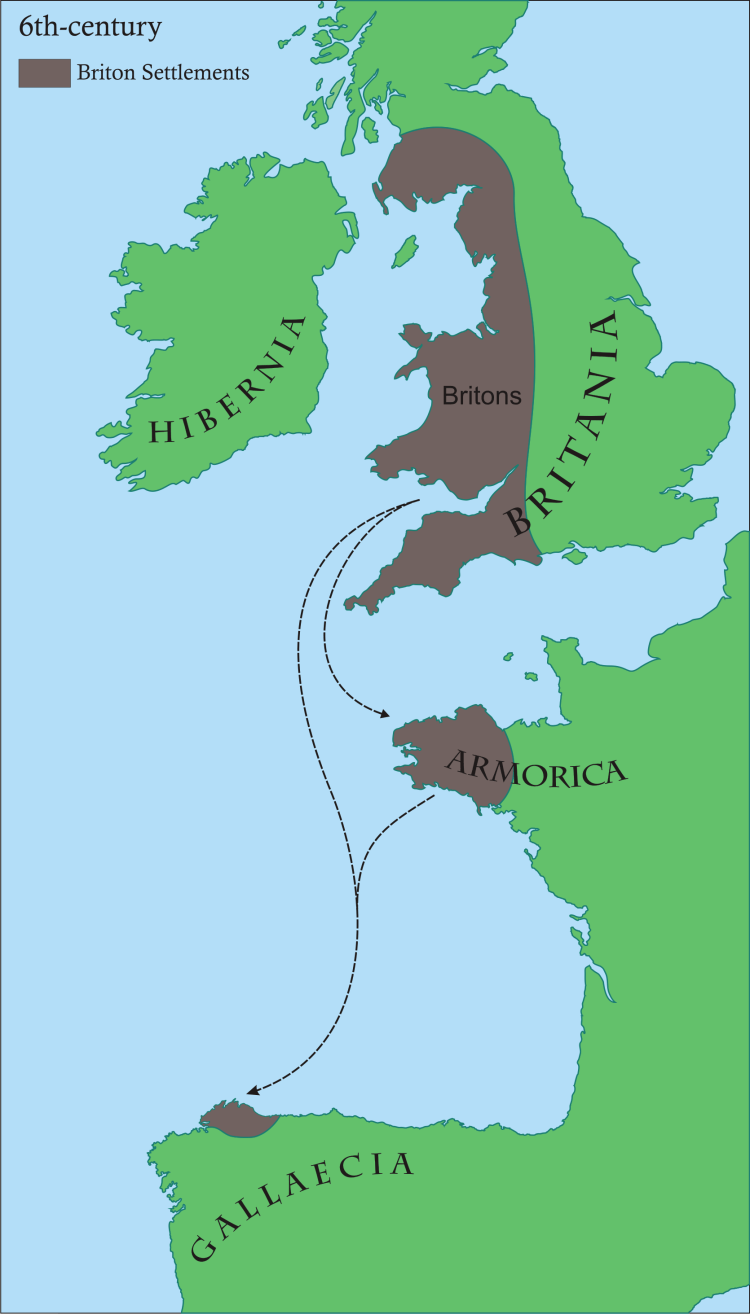
Briton settlements in the 6th century – settlements of the Angles, Saxons and Jutes in Britain, circa 600 In the following, Briton will refer to the Celtic Brittonic-speaking peoples who inhabited Britain south of the Firth of Forth, and who, following the arrival of the Anglo-Saxons in the 5th century, gradually retreated until the […]
The Anglo-Saxons were the Germanic inhabitants of England before the Conquest, i.e. the invasion and assumption of control by William of Normandy in 1066. Known as William the Conqueror, William I (circa 1027-87) defeated Harold II at the Battle of Hastings. He introduced Norman institutions and customs, including feudalism, and instigated the Domesday Book. […]
The English adjective pregnant has several meanings: carrying a fetus or fetuses within the womb, full of meaning or significance, inventive or imaginative, prolific or fruitful. It is from the Latin adjective praegnans/praegnant-, with child, pregnant, variant of praegnas/praegnat-, probably from the prefix prae-, before, and the stem of the verb gnasci (past participle gnatus), […]


 word histories