In his comédie-ballet Le Bourgeois gentilhomme (literally The Bourgeois Gentleman – 1670), the French playwright and actor Molière (Jean-Baptiste Poquelin – 1622-73) invented the word Mamamouchi, an imaginary Turkish title that Monsieur Jourdain is gulled into thinking the son of the Grand Turk confers upon him. (Jourdain is a bourgeois whose aim is to be […]
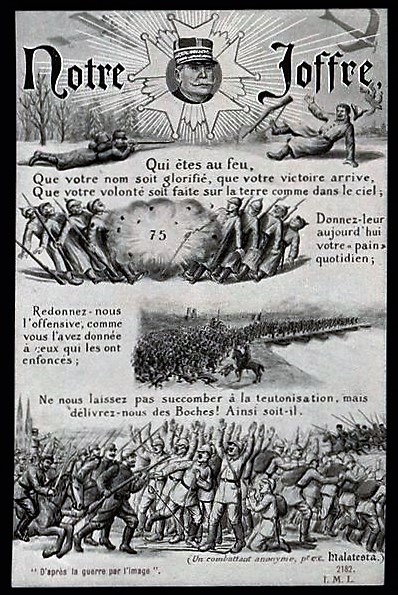
Notre Joffre (parody of the Lord’s Prayer) first published in 1914 in Le Radical de Marseille (75 refers to the French 75-mm field gun.) From 1914 to 1916, Joseph Joffre (1852-1931) was the commander in chief of the French armies on the Western Front. The following parody of the Lord’s Prayer is to be replaced […]
MEANINGS – attractive articles of little value or use – practices or beliefs that are superficially or visually appealing but have little real value or worth ORIGIN The noun trumpery, first recorded in the mid-15th century, is from the French noun tromperie, which means deception, trickery. This was one of the original meanings in […]
The phrase to teach one’s grandmother to suck eggs means to presume to advise a more experienced person. Raw eggs, with or without a little seasoning, used to be a popular food and were regarded as healthy. Grandmothers obviously needed no instruction about how to drink them. The phrase is first recorded in a translation from Spanish by […]
The term field bishop denotes a person who is hanged and imagined as grotesquely giving a benediction with his jerking legs. It is first recorded in A mysterye of inyquyte contayned within the heretycall genealogye of Ponce Pantolabus (1545), by John Bale (1495-1563), Bishop of Ossory, evangelical polemicist and historian: What your ende shall be […]
MEANING of payments: without delay ORIGIN This expression refers to the fingernail and might originally have alluded to drinking fair and square. A clue might be provided by the French phrase payer rubis sur l’ongle (literally to pay ruby on the fingernail), which means to pay exactly what is due. (A variant, used by prostitutes, was rubis sur pieu, […]
The Ranz des Vaches – from A Complete Dictionary of Music (1779) The term ranz-des-vaches denotes a type of Swiss melody, traditionally played on the Alpenhorn or sung in order to call cows scattered over the mountainside. The melody is characterised by the reiteration of short phrases and usually contains an element […]
Unexpectedly, the words fawn, meaning a young deer in its first year, and fetus (or foetus), meaning an unborn or unhatched offspring of a mammal, are doublets: they go back to the same etymological source but differ in form and meaning. While fetus has remained identical to this source, the form fawn is the result of sound changes—cf. also turban – tulip, clock – cloak, […]
Among other figurative meanings, the adjective thick has the sense of close in confidence and association, intimate, familiar. In Literary Anecdotes of the Eighteenth Century, published in 1812, John Nichols quoted Edmund Law (1703-87), Bishop of Carlisle: “Yes,” said he, “we begin now, though contrary to my expectation, and without my seeking, to be pretty thick; and I thank God, who reconciles me to […]
The noun myrmidon denotes a follower or subordinate of a powerful person, typically one who is unscrupulous or carries out orders unquestioningly. This word first appeared in the plural forms Mirmydanes and Murmindones in The Laud Troy book, a poem about the siege of Troy composed around 1400. It is from the classical Latin plural […]


 word histories