The verb nail is used to mean to expose or reveal the falsehood of an allegation, assertion, etc., especially to prevent further dissemination. This use is first recorded in An Oration delivered at the Celebration in Philadelphia of the 106th Anniversary of the Birthday of Thomas Paine, by John Alberger, published in The North American […]
The noun myrmidon denotes a follower or subordinate of a powerful person, typically one who is unscrupulous or carries out orders unquestioningly. This word first appeared in the plural forms Mirmydanes and Murmindones in The Laud Troy book, a poem about the siege of Troy composed around 1400. It is from the classical Latin plural […]
“HUNS KILL WOMEN AND CHILDREN!” “TELL THAT TO THE MARINES!” First-World-War US recruiting poster by James Montgomery Flagg image: Disappearing Idioms This poster, which attracted a great deal of attention, portrays an angry-looking young man in the act of pulling off his coat as though he were anxious to get into a fight. The […]
Le Rhesus (Simia Rhesus) – illustration by Jean-Baptiste Audebert for his treatise, Histoire naturelle des singes et des makis (1799) – image: Bibliothèque nationale de France / gallica.bnf.fr This word is from French rhésus, formerly rhesus, and from its etymon, the scientific Latin (Simia) Rhesus. In Histoire naturelle des singes et des makis (Natural […]
The noun fly-by-night, or fly-by-nighter, denotes an unreliable or untrustworthy person. As an adjective, fly-by-night means unreliable or untrustworthy, especially in business or financial matters. However, the term seems to go back to the idea of witches flying on their broomsticks by night. At least, its first recorded instance is as a term of contempt […]
The noun window is from Middle English windoȝe, a borrowing from Old Norse vindauga, literally wind’s eye, from vindr, wind, and auga, eye. The Scandinavian word replaced and finally superseded Old English éagþyrel, i.e. eyethirl, composed of the nouns eye and thirl. The noun thirl denoted a hole, an aperture, and was derived from Old English þurh, thorough. It was long used in some dialects of English; for instance, […]
The compound apple-pie order means perfect order or neatness. Its first known user was a British Royal Navy officer, Admiral Sir Thomas Pasley (1734-1808), in his journal in 1780: Exercised Great Guns and small Arms as I constantly do every Tuesday and Friday, and fired Volleys; Wash and Fumigate, Wednesdays and Saturdays, Air Spare Sails […]
The term Richard Snary is an alteration, with humorous substitution of Richard for the pet-form Dick, of Dick Snary, itself a humorous remodelling of dictionary. These terms are first recorded in Apollo shrouing composed for the schollars of the free-schoole of Hadleigh in Suffolke. And acted by them on Shrouetuesday, being the sixt of February, 1626, by William Hawkins (died 1637): – I […]
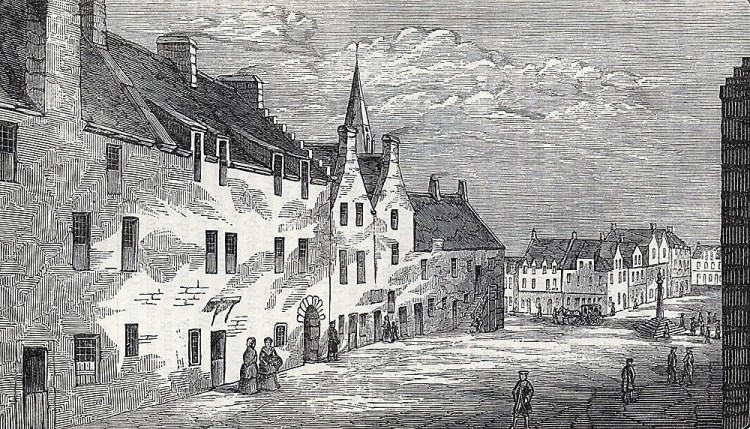
the Rotten-row in Glasgow, circa 1570 image: The Glasgow Story The street name Rotten Row occurs in many different towns. For example, The Caledonian Mercury (Edinburgh) of 10th December 1728 published the following advertisement: There is just come to Leith, a Parcel of fine Figs both in Casks and Frails [= baskets], […]
The phrase at sixes and sevens means in a state of total confusion or disarray. Based on the language of dicing, the phrase was originally to set (all) on six and seven. It denoted the hazard of one’s whole fortune, or carelessness as to the consequences of one’s actions. From this earlier association with reckless behaviour came the idea that things in […]