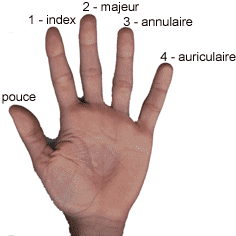
In the Etymologies (Etymologiarum sive Originum libri viginti), compiled between around 615 and the early 630s in the form of an encyclopaedia arranged by subject matter, St Isidore (circa 560–636), bishop of Seville and Doctor of the Church, wrote the following about the names of the fingers (the original Latin words are […]
The Italian noun gianduia (improperly gianduja) appeared in the 19th century to denote a soft confection made with chocolate and ground hazelnuts, first produced in Turin, the capital of Piedmont, a region in north-western Italy, in the foothills of the Alps. (The Italian name is Piemonte, from piede, foot, and monte, mount.) This confection was […]
The French masculine noun sanglier denotes a full-grown wild boar. It literally means a boar living on its own, separated from the herd, since, via Old and Middle French forms such as sengler and senglier, it is from the popular Latin singularis (porcus), solitary (pig) – cf. Middle-French terms such as porc sanglier, and in the Vulgate, the Latin version of the Bible, singularis ferus, the noun ferus meaning wild animal (cf. the […]
In The Tragedie of Macbeth (around 1603), by the English poet and playwright William Shakespeare (1564-1616), Gray-Malkin is the name of a fiend in the shape of a grey she-cat, the cat being the form most generally assumed by the familiar spirits of witches according to a common superstition: (Folio 1, 1623) […]
MEANING to have no hesitation in stating, or dealing with, something, however unpleasant or awkward it is ORIGIN Always used in the negative, this phrase dates back to the 16th century, originally as to make no bones at or in. It also occurred without a complement, as in its first recorded use, in The first tome or […]
The adjective fed up means annoyed, unhappy or bored, especially with a situation that has existed for a long time. The original, literal meaning is simply sated with food, since to feed up an animal or a person is to supply them with rich and abundant food. For example, the author of Whether Love be a natural or fictitious Passion, published in Pope’s Bath Chronicle of 3rd May 1764, wrote: The […]
In the chapter Our lunatic contributor of Words and names (1933), the British philologist Ernest Weekley (1865-1954) wrote: The correspondence columns of our middlebrow weeklies and of our two Sunday papers are the happy hunting-ground of the amateur etymologist. A few years ago he published the discovery that ‘nap,’ ‘a short sleep,’ was derived from Napoleon’s power of sleeping […]
MEANING to pay excessively, to be charged exorbitantly PROBABLE ORIGIN The expression to pay through the nose is first recorded in Piazza universale di proverbi Italiani, or, A common place of Italian proverbs and proverbial phrases digested in alphabetical order (1666), by Giovanni Torriano (floruit 1640): Oft-times Rich men engrossing commodities, will make one pay through the […]
A blend of magpie and piety, the word magpiety was originally invented by the English poet and humorist Thomas Hood (1799-1845) to denote talkativeness, garrulity, especially on religious or moral topics and affected piety. This author first used the word in Jarvis and Mrs. Cope, published in The New Sporting Magazine of March 1832; the poem thus begins: JARVIS AND MRS. COPE. A decidedly serious […]
The Latin noun lupus/-pi meant wolf. It is kindred with ancient Greek λύκος (lukos). —Cf. lycanthrope, which originally designated a person who believes that he or she is a wolf, and which, via the modern Latin noun lycanthrōpus, is from Greek λυκάνθρωπος (lukanthropos), literally wolf-man, from λύκος and ἄνθρωπος (anthropos), man. The Latin lupus has sometimes been used in English in the sense of wolf; for instance, a Scottish […]