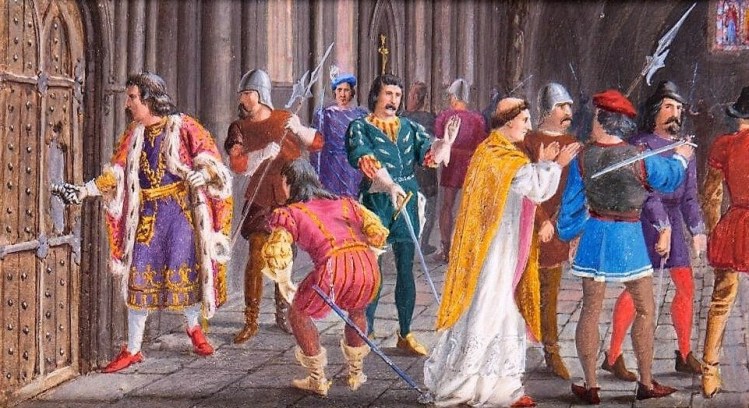
Four’s a Crowd.—A merry, irresponsible farce that dips frequently into pure crazy comedy. For this they have chosen to give Errol Flynn and Olivia de Havilland a “break” from their usual story book hero and heroine types. These two lovely young people do very well, but I cannot think that crazy comedy suits them best. […]
The informal British phrase to chance one’s arm means to undertake something although it may be dangerous or unsuccessful. Its origin is unclear. The earliest use that I have found is from How our blue-jackets are fed, an article about the “diet of the British sailor at sea” published in The Weekly Telegraph […]
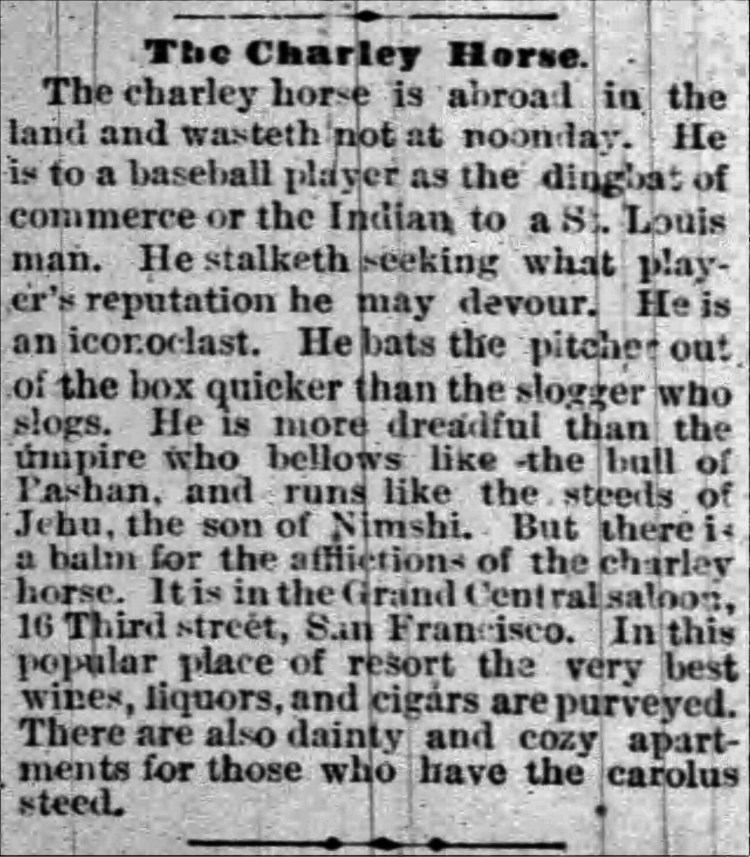
The Charley Horse. The charley horse is abroad in the land and wasteth not at noonday. He is to a baseball player as the dingbat of commerce or the Indian to a St. Louis man. He stalketh seeking what player’s reputation he may devour. He is an iconoclast. He bats the pitcher out of […]
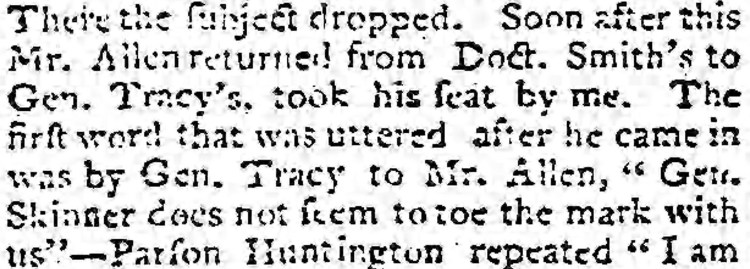
The phrase to toe the line means to accept the authority, policies or principles of a particular group, especially unwillingly. Its literal sense is to stand or crouch with the toes touching the line, especially at the start of a race or fight. The current meaning is an extension of a figurative usage, […]
In cricket, from the resemblance between the figure 0 and a duck’s egg, the term duck’s egg denotes the zero (i.e. 0) placed against a batsman’s name in the scoring sheet when he fails to score. This was explained in Very Hard Cash (1863), a novel by the English novelist and playwright Charles Reade (1814-84): […]
The phrase not to give, care or be worth a tinker¹’s curse, cuss² or damn (or elliptically a tinker’s) is an intensification of not to give, care or be worth a curse, cuss or damn, with reference to the bad language reputedly used by tinkers. The low repute in which tinkers were held is also […]
The name Hogs Norton, also Hog’s Norton and Hogsnorton, denotes a fictional town renowned for its uncultured and boorish inhabitants. It has often been used in depreciative phrases suggesting that someone is a native or inhabitant of this town. These phrases have variously associated the name: – with present-day Hook Norton, a town in Oxfordshire […]
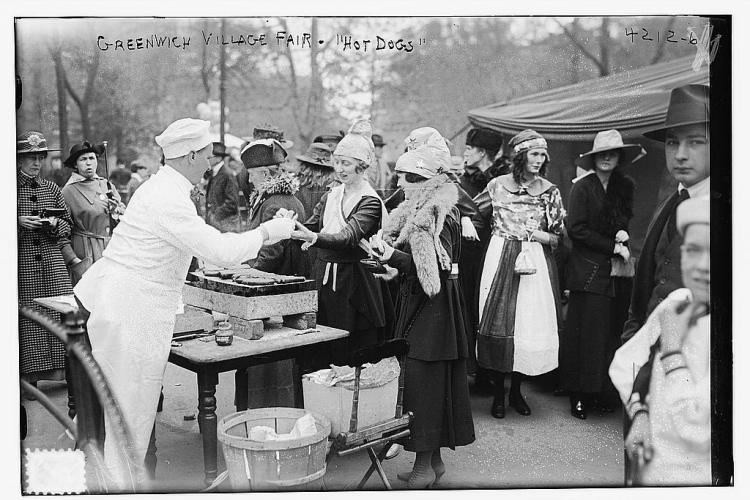
Greenwich Village Fair – “Hot Dogs” – June 1917 photograph: Library of Congress The term hot dog denotes a sausage, especially a frankfurter, served hot in a long roll split lengthways. In US slang, the noun dog has been used to denote a sausage since the late 19th century. This usage is first recorded […]
photograph: Farm Shop The noun mayonnaise denotes a thick, creamy sauce consisting of egg yolks emulsified with oil and seasoned, used as a cold dressing or accompaniment for salad, eggs, fish, etc., or as the base for other sauces. It is used in two French phrases: la mayonnaise prend, literally, the mayonnaise […]
The phrase to leave no stone unturned means to try every possible course of action in order to achieve something. (The equivalent French phrase has a cosmic dimension since it is remuer ciel et terre, literally, to move heaven and earth.) The image of turning every stone was already proverbial over 2000 years ago in […]