robotically conformist or obedient—from The Stepford Wives (1972 novel by Ira Levin and 1975 film adaptation by Bryan Forbes), in which Stepford is the name of a superficially idyllic suburb where the men have replaced their wives with obedient robots
‘the milk in the coconut’: a puzzling fact or circumstance; alludes to the question of how the milk got into the coconut—of British-English origin (1832), not of American-English origin as stated by the Oxford English Dictionary
USA, 1914—‘ailurophile’: a cat lover—‘ailurophobe’: opposite sense—based on ancient Greek ‘aílouros’, ‘cat’, perhaps from ‘aiόlos’, ‘swift’, and ‘ourá’, ‘tail’, the cat being perhaps so called on account of the swift movement to and fro of its tail
from the notion that even a dead cat will bounce if dropped from a sufficient height—UK, 1981: a rapid fall in the stock market with hardly any reaction—USA, 1985: a rapid but short-lived recovery in the stock market after a sharp fall—hence, 1992: any spurious success
‘a stiff upper lip’: a quality of uncomplaining stoicism—now understood as referring to what is believed to be a quintessentially British trait, the repression of emotion, but originated in fact in North America (USA, 1811)
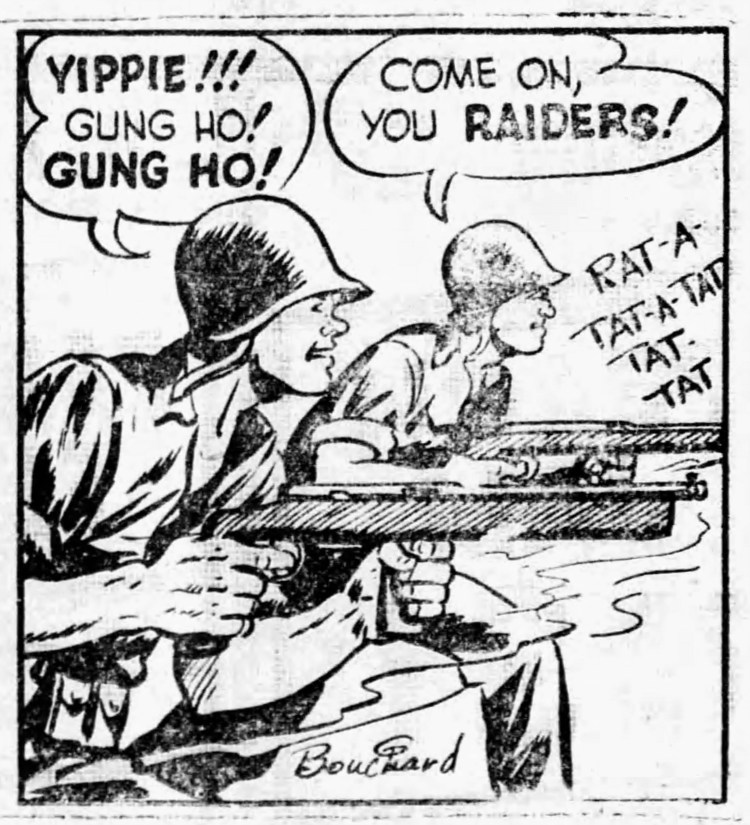
from Chinese ‘gōnghé’, short for ‘Zhōngguó Gōngyè Hézuò Shè’ (Chinese Industrial Cooperative Society)—interpreted as a slogan meaning ‘work together’ (USA, 1941)—adopted by Evans F. Carlson, commander of the 2nd Marine Raider Battalion (1942)
UK, 1945—‘demob happy’: feeling elated in anticipation of demobilisation from the armed forces—hence: in anticipation of the end of a job, assignment, etc.—in extended use: in anticipation of the end of any onerous or unpleasant period
UK, 1823—‘a hurried departure at night, especially from rented accommodation to avoid payment of rent owed’—‘flit’, noun use of ‘to flit’, originally used in Scotland and Northern England to mean ‘to move house or leave one’s home’
UK, 1831—to startle or upset a sedate or conventionally-minded community—most probably from the following lines in The Tragedy of Coriolanus (circa 1607), by William Shakespeare: “like an eagle in a dove-cote, I | Flutter’d your Volscians in Corioli”
USA, Boston Morning Post, 26 May 1834—‘Dutch uncle’: a person giving firm but benevolent advice—unknown origin—perhaps an allusion to Calvinistic sternness

 word histories