‘conchie’: meaning and origin
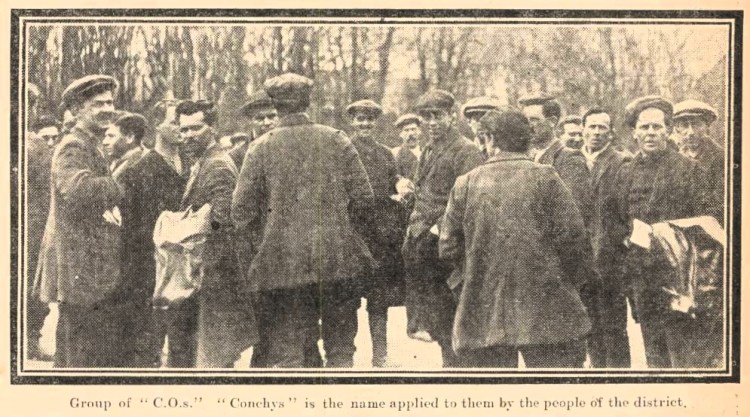
a conscientious objector—UK, 1916—from the initial syllable of the noun ‘conscientious objector’ and the suffix ‘-ie’, used to form familiar diminutives
Read More
“ad fontes!”
a conscientious objector—UK, 1916—from the initial syllable of the noun ‘conscientious objector’ and the suffix ‘-ie’, used to form familiar diminutives
Read Morea container used to store for posterity a selection of objects thought to be representative of a particular moment in time—USA, 1938—coined to specifically designate the container built by the Westinghouse Electric and Manufacturing Company for the 1939 New York World’s Fair
Read MoreUK, 1931—sports (originally golf): a style of play characterised by an emphasis on luck rather than skill—the image is of a golfer who trusts to luck when hitting the ball
Read MoreUSA, 1982—characteristic, reminiscent or imitative of the films or television work of the U.S. filmmaker David Lynch (1946-2025)—also ‘Lynchean’, ‘David-Lynchian’ and ‘David-Lynchean’
Read Morethree daily meals plus a bed for the night (i.e., basic food and shelter)—USA, 1929—chiefly used in relation to the military, prison, and shelters for homeless people—‘hot’ designates a hot meal
Read More1901—a look inviting sexual interest—hence, the adjective ‘bedroom-eyed’ (1925), which means: giving a look inviting sexual interest
Read Moreoriginally (1830): the rule, or the power, of paper money (as opposed to metallic currency)—later also (1940): the rule, or the power, of bureaucracy
Read More(intransitive): to spend the summer—UK, 1797, in the following title: The Sea Side, a Poem, in a Series of familiar Epistles, from Mr. Simkin Slenderwit, summerising at Ramsgate, to his dear Mother in Town
Read Morevery boring or unexciting—‘(as) dull as ditchwater’ (1770)—the later phrase ‘(as) dull as dishwater’ (1832) is probably due to mispronunciation of ‘ditchwater’ in the original phrase
Read Moreto describe or portray someone or something in very general terms, avoiding or neglecting the finer details—UK, 1808—alludes to a style of painting characterised by the use of broad brushstrokes
Read More word histories